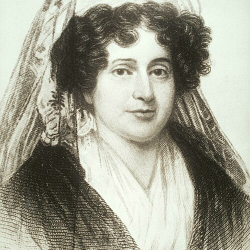
Born: 23 February 1787, Berlin, Connecticut, United States
Died: 15 April 1870, Troy, New York, United States
Nationality: American
Emma Willard was an American educator, author and advocate for women's education, best known as the founder of Troy Female Seminary.
Emma Willard
Journal and Letters from France and Great Britain
Troy, N.Y., 1833.
May 14th [1831]
Dear Sister,
I am on the whole, better pleased with London, than I expected to be...The gravel walks, winding along, often bordered with beautiful flowers which the season now brings forth in all their perfection - these objects of rural beauty I did not expect to find in London, particularly to find them so often repeated, and on so grand a scale as they are in Regent's Park... Here the elegance of the views is heightened by the most exquisite scenery, which tranquil water can present. Sloping banks with elegant villas embosomed in trees - where sometimes the aged oak towers majestically, sometimes the young willow gracefully sweeps the turf beneath, or the laburnum waves her yellow tresses to the slightest breeze...This elegant scenery rises around a delicious island, near which the swan presses her snowy bosom to the waters, and sails proudly along...
In a letter of introduction the novelist Maria Edgeworth had written: 'The bearer of this note is...an American lady, who has a celebrated establishment for the education of young people near New York; and who is well known by her literary publications...She has been travelling on the continent for the purpose of seeing the establishments of education in Paris; and...in London'. Edgeworth herself had been scornful of the new Regent's Park, and Mrs. Willard confessed to a slight disappointment.
Alas, in this cheating world, all is not gold that glitters. When I first rode about Regent's Park, I supposed the elegant buildings there seen, were the residences of the nobility, and I did not observe other, than their general splendid effect. But I afterwards found that they were all divided into residences, to be let to private gentlemen. With one of their tenants, Mr. T --, we partook of an elegant dinner, and he told us they were made more for show, than convenience. They are not of stone, but of brick stuccoed on the outside