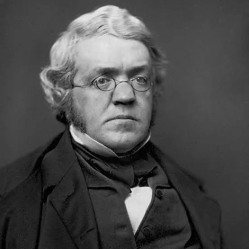
Born: 18 July 1811, Calcutta, India
Died: 24 December 1863, London, England
Nationality: English
William Makepeace Thackeray was an English novelist and satirist, best known for Vanity Fair and for his sharp social observation of nineteenth-century British life.
William Makepeace Thackeray
Catherine: A Story
1839. Reprinted in The Works of William Makepeace Thackeray, Vol. 11. Smith, Elder & Co., 1889.
There was given, at Marylebone Gardens, a grand concert and entertainment...After the dancing, the music, and the fireworks, Monsieur de Galgenstein felt the strange and welcome pangs of appetite, and was picking a cold chicken...along with some other friends in an arbour when he was led to remark that a very handsome plump little person, in a gorgeous stiff damask gown and petticoat, was sauntering up and down the walk running opposite his supping-place, and bestowing continual glances towards his Excellency. The lady, whoever she was, was in a mask...and had a male companion. He was a lad of only seventeen, marvellously well dressed - indeed, no other than the Count's own son, Mr. Thomas Billings
The plump little person is Catherine, whose affair with Count Galgenstein in the distant past had resulted in Thomas Billings. Catherine's 'ancient lover' fails to recognize her behind the mask; intrigued as to who she might be, he invites her to join him for a drink. Tom meanwhile encounters his beloved, Polly Briggs, in the company of another man, and challenges him to a fight.
How the brawl might have ended, no one can say, had the two gentlemen actually crossed swords; but Mrs. Polly, with a wonderful presence of mind, restored peace by exclaiming, "Hush, hush! the beaks, the beaks!" Upon which, with one common instinct, the whole party made a rush for the garden gates, and disappeared into the fields. Mrs. Briggs knew her company: there was something in the very name of a constable which sent them all a-flying
The Bedford Row Conspiracy
1840. Reprinted in A Shabby Genteel Story and Other Tales. D. Appleton & Co., 1853.
The intimacy of these young persons had, in fact, become so close, that on a certain sunshiny Sunday in December, after having accompanied aunt Riggs to church, they had pursued their walk: as far as that rendezvous of lovers - the Regent's Park, and were talking of their coming marriage with much confidential tenderness, before the bears in the Zoological Gardens. Miss Lucy was ever and anon feeding those interesting animals with buns, to perform which act of charity, she had clambered up on the parapet which surrounds their den
Lucy, niece of the wealthy Lady Gorgon, had not thought it 'at all necessary to inform her ladyship how deeply she was smitten by the wicked young gentleman who had made all the disturbance at the Oldborough ball.' Unexpectedly encountering the Gorgon entourage at the Zoo, she has to confess.
"An engagement without consulting your guardians!" screamed her ladyship, "this must be looked to! Jerningham, call round my carriage...Miss Gorgon, I will thank you to follow me immediately;" and so saying...the lady bustled away forwards, the files of Gorgon daughters and governess closing round and enveloping poor Lucy, who found herself carried forward against her will, and in a minute seated in her aunt's coach, along with that tremendous person
Vanity Fair
1847. Dent Everyman, 1963.
The Marquess of Hertford, who owned Hertford Villa in the park, was the model for the fictional Marquess of Steyne, but in the novel Steyne lives in 'Gaunt Square'. Only fleeting references to the park, e.g. where he drives around it in a carriage with Becky Sharp.
The Virginians: A Tale of the Last Century
1859. Smith, Elder & Co., 1901.
Harry Warrington, scion of a wealthy tobacco-growing family in Virginia (then a British colony), has arrived in England in 1756, accompanied by his black servant Mr. Gumbo. After a lengthy stay with his Hampshire relatives he is keen for more lively company.
Reading in the London Advertiser, which was served to his worship with his breakfast, an invitation to all lovers of manly British sport to come and witness a trial of skill between the great champions Sutton and Figg, Mr. Warrington determined upon attending these performances, and accordingly proceeded to the Wooden House, in Marybone Fields...He reached his destination at length...and found no small company assembled to witness the valorous achievements of the two champions
Sutton and Figg were real characters, and this contest was the subject of a poem by James Byrom: 'Long was the great Figg, by the prize-fighting swains, / Sole monarch acknowledg'd of Mary-bone plains...' (A Collection of Poems in Six Volumes, By Several Hands. Ed. R. & J. Dodsley. J. Hughes, 1758. Vol. 6). Other sources give the venue as the Boarded House in the Bear Garden at Marylebone, and the date as 1727 - some 30 years before Harry's visit.
A crowd of London blackguards was gathered round the doors of this temple of British valour...a variety of beggars and cripples hustled round the young gentleman, and whined to him for charity...Mr. Gumbo took his seat in the amphitheatre below; or, when tired, issued forth into the outer world to drink a pot of beer, or play a game at cards with his brother-lacqueys, and the gentlemen's coachmen on the boxes of the carriages waiting without. Lacqueys, liveries, footmen - the old society was encumbered with a prodigious quantity of these...They guzzled, devoured, debauched, cheated, played cards, bullied visitors for vails - that noble old race of footmen is well-nigh gone