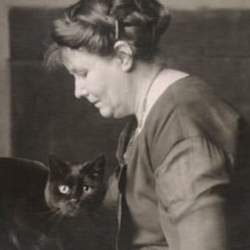
Born: 24 August 1863, Rock Ferry, Cheshire, England
Died: 14 November 1946, Bierton, Buckinghamshire, England
Nationality: British
May Sinclair was the pen name of Mary Amelia St Clair, a British novelist, poet, critic, suffragist, and early modernist writer.
May Sinclair
Superseded
1906.
And now, on early evenings and Saturday afternoons when the weather was fine, Miss Quincey was to be found in Primrose Hill Park. Not that anybody ever came to look for Miss Quincey. Nevertheless, whether she was walking up and down the paths or sitting on a bench, Miss Quincey had a certain expectant air, as if at any moment Dr. Cautley might come tearing round the corner with his coat-tails flying...At last she saw him; she saw him twice running...Each time he was walking very fast as usual, and he looked at her, but he never raised his hat; she spoke, but he passed her without a word. And yet he had recognised her; there could be no possible doubt of it
At an earlier encounter on the hill Miss Quincey felt that the doctor had shown a particular interest in her, even though his patriarchal views on the role of women were at odds with her own tentative feminism. His behaviour today is to cause great emotional turmoil. Months later she believes she has overcome these feelings, but another visit to the scene of their first meeting will wreck her tranquillity.
This morning Miss Quincey's heart protested so violently against her notion of ascending Primrose Hill...that Miss Quincey unwillingly gave in and contented herself with a seat in one of the lower walks of the park. There she leaned back and looked about her, but with no permanent interest in one thing more than another...all the time her eyes were busy, now with a bush of May in crimson blossom, now with the many-pointed leaves of a sycamore pricked against the blue; now with the straight rectangular paths that made the park an immense mathematical diagram. From where she sat her eyes swept the length of the wide walk that cuts the green from east to west. Far down at the west end was a seat, and she could see two people, a man and a woman, sitting on it...
A younger, more attractive rival has supplanted her.
I have not been able to find a printed copy of this book but the full text is available from Project Gutenberg.
The Divine Fire
Eveleigh Nash, 1911.
He chose his moment with discretion, when time and place and Flossie's mood were most propitious. The time was Sunday evening, the place was the Regent's Park, Flossie's mood was gentle and demure. She had been very nice to him since his father's death, and had shown him many careful small attentions...The flowers were gay in the Broad Walk, Flossie tried to be gay too; and called on him to admire their beauty. They sat down together on a seat in the embrasure of a bed of chrysanthemums. Flossie was interested in everything, in the chrysanthemums, in the weather and in the passers-by - most particularly interested, he noticed, in the family groups
Keith had 'long ago divined her heart' and now finds that he 'could not meet that look in Flossie's eyes when he thought of what he had to say to her.' They walk on, and 'under a solitary tree by the path that goes towards St. John's Wood, he broke it to her gently.'
Nothing would ever be the same again; that was clear. The flowers were still gay in the Broad Walk, and the children, though a little sleepier, were still adorable; but Flossie did not turn to look at them as she passed. Would she ever look at them, at anything, with pleasure again? He had made life very difficult, very cruel to this poor child, whom after all he had promised to protect and care for