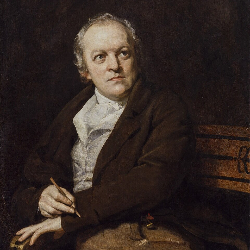
William Blake was an English poet, painter and printmaker. Largely neglected during his lifetime, he later became a central figure in Romantic poetry and visionary art.
William Blake
Poems and Prophecies
Everyman/Dent, 1950.
From Jerusalem, Chapter 2 (To the Jews), early 19th century:
The fields from Islington to Marybone,
To Primrose Hill and Saint John's Wood,
Were builded over with pillars of gold,
And there Jerusalem's pillars stood.Her Little-ones ran on the fields,
The Lamb of God among them seen...The Jew's-harp-house & the Green Man,
The Ponds where Boys to bathe delight,
The fields of Cows by Willan's farm,
Shine in Jerusalem's pleasant sight.
The Jew's Harp inn was a popular rendezvous in Marylebone Park. It stood next to Willan's Farm, where Leigh Hunt remembered having eaten 'creams and other country messes' in the days before 'the dear old fields' were redeveloped as Regent's Park. Blake's most famous verse, 'And did those feet in ancient time', will not be found in this poem, whose subject is the fallen condition of Man and the forces that will redeem him. London is imagined as the historical Jerusalem.
Henry Crabb Robinson, in his Diaries, Reminiscences and Correspondence (ed T. Sadler, Macmillan, 2 vols, 1872), recalls Blake telling him, 'I have conversed with the spiritual Sun. I saw him on Primrose Hill. He said, "Do you take me for the Greek Apollo? - "No", I said, "that (pointing to the sky) is the Greek Apollo. He is Satan"' (Aphorisms from Blake).